

Table of Contents
- How Wig Density Affects a Natural Look
- Wig Density Chart Explained: What the Numbers Mean
- Is 150% Density Too Thick for a Wig?
- Matching Density to Hair Length and Face Shape
- How to Make a Wig Look More Realistic
- Getting the Density Right with a Bespoke Consultation
- Frequently Asked Questions
Last Updated: September 20, 2026
How Wig Density Affects a Natural Look
Wig density is the amount of hair on a wig, measured by how closely strands are packed together. Get it wrong and even premium hair looks like a costume. Get it right and nobody can tell where your hairline ends.
At Wigs Ldn, we see this every week. Clients come in wearing a wig that fits well but still reads as fake. Nine times out of ten, the density is the problem.
So what actually happens when density is too high?
- The hair sits too far off the scalp, creating bulk where there should be none
- Partings look solid and flat instead of showing scalp
- The hairline looks heavy, like a thick band across the forehead
- Styling becomes harder because the hair has no movement
Natural hair has variation. It is thinner at the hairline and temples, fuller through the crown, and lighter at the ends. A wig with one uniform density throughout fights against that pattern.
The goal is simple: match the density to where hair naturally grows thickest and thinnest on a real head. Below, we break down exactly how to do that.
NHS information on hair loss and wigs
Wig Density Chart Explained: What the Numbers Mean
A wig density chart shows the percentage of hair coverage on a wig compared to a full head of natural hair. Most wigs sit between 80% and 200%. The number tells you how full the wig will look, not how thick each strand is.
Here is the part most guides miss: density and hair thickness are two separate things. A 130% density wig made from fine European hair looks completely different from a 130% wig made from coarse strands.
Standard Density Ranges at a Glance
| Density | Look | Best For |
|---|---|---|
| 80-100% | Very fine, flat to scalp | Fine natural hair, thinning crown |
| 110-130% | Light and realistic | Everyday wear, most face shapes |
| 140-150% | Medium-full | Longer lengths, styling volume |
| 160-180% | Full and thick | Dramatic styles, short cuts |
| 190%+ | Very heavy | Stage, drag, editorial looks |
For most people wanting a natural look, 110-130% is the sweet spot. It gives enough coverage without bulk.
Is 150% Density Too Thick for a Wig?
Not always, but often. A 150% density wig suits longer hair, fuller face shapes, and anyone who wants visible volume. It looks wrong on short styles, fine hair types, and anyone with a delicate bone structure.
Think about it this way. If your natural hair is fine and you wear a 150% density wig in a chin-length bob, the hair will sit like a helmet. Real hair at that length has weight and falls flat. The wig will not.
Where 150% works well:
- Hair past shoulder length, where weight pulls the density down
- Clients with rounder or square face shapes who need balance
- Anyone transitioning from very thick natural hair
Where it fails:
- Pixie cuts and short bobs
- Fine or thinning natural hair
- Pale skin tones, where heavy density casts shadows at the hairline
A common mistake is assuming more density means better quality. It does not. It means more hair, which is not the same thing.
Matching Density to Hair Length and Face Shape
Density should follow two rules: shorter hair needs lighter density, and softer features need lighter density. Everything else is adjustment.
For length, the pattern is consistent:
- Short cuts (above the chin): 100-120%
- Shoulder length: 120-140%
- Mid-back: 140-160%
- Waist and beyond: 150-180%
Longer hair carries more weight, so it can handle more density without looking bulky.
For face shape, the logic flips. Fuller faces suit fuller density because the hair balances the width. Narrower faces need lighter density so the hair does not overwhelm the features.
Skin tone matters too, and most guides skip it. If you have fair skin, a dense hairline casts a shadow that gives the wig away. Lighter density at the front solves this.
How to Make a Wig Look More Realistic
Realism comes from three things working together: density, lace, and hairline placement. Fix one and the others still give you away. Fix all three and the wig disappears.
Start with density, since it is the foundation. Then look at the lace.
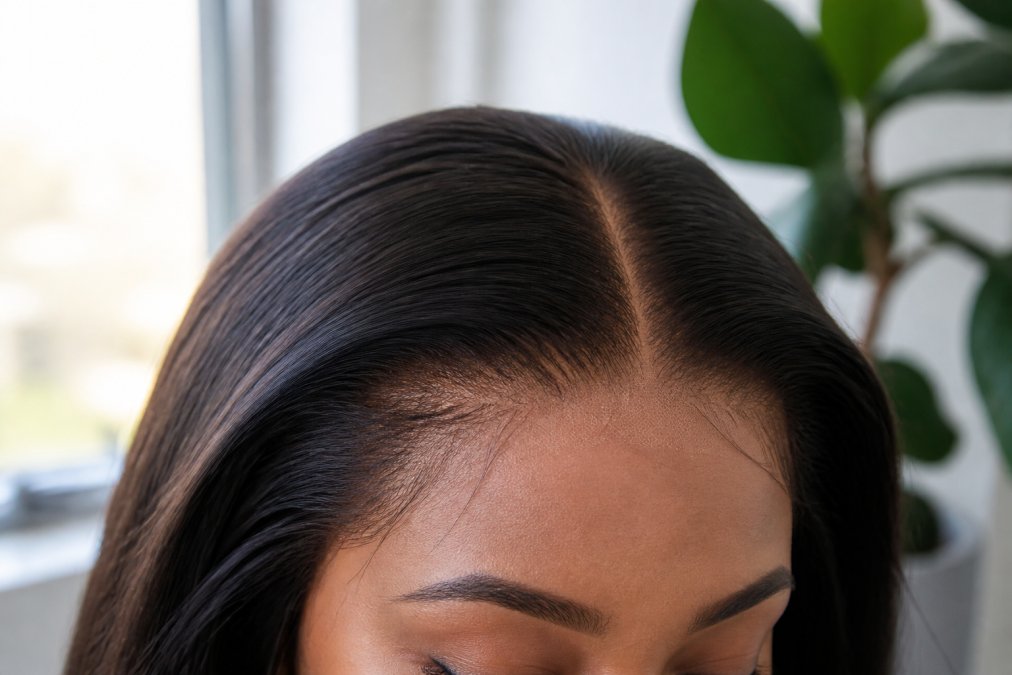
Lace, Hairline and Density Working Together
Lace is the thin mesh the hair is tied into at the front. It should match your scalp tone so the knots disappear. If the lace is too dark or too shiny, the hairline looks painted on.
Density and lace interact in a specific way. A dense hairline on visible lace looks fake, because you can see the mesh straining under the weight. A lighter hairline density lets the lace sit flat and blend.
Practical steps for a more realistic finish:
- Choose a lace colour that matches your scalp, not your hair
- Ask for lighter density at the front 1-2cm of the hairline
- Pluck a few hairs at the very front edge to soften the line
- Keep the parting slightly off-centre, since real partings rarely sit dead centre
- Avoid heavy styling products at the hairline, which make lace shine
Getting the Density Right with a Bespoke Consultation
Choosing wig density for a natural look is hard to do from a photo or a size chart. Density interacts with your face, your skin tone, and your natural hair, and none of that translates well through a screen.
This is where a proper consultation earns its place. At Wigs Ldn, our Luxury Wig Consultation lets you try sample wigs, compare densities side by side, and see how each one sits against your face. The session runs about 30 minutes and costs £50, with £25 redeemable against your wig purchase on the same day.

If you cannot attend in person, the DIY Wig Head Measurement Kit covers the fit side of things. It costs £5 and includes a professional tape measure plus step-by-step guidance by email or WhatsApp. The cost is refunded when you buy a wig or a custom service.
Both routes lead to the same place: a made-to-order wig built around your measurements and your density choice, not a stock size.
Frequently Asked Questions
What is the most natural-looking wig density?
Most natural-looking wigs sit between 130% and 150% density. This range mimics the volume of healthy biological hair without looking bulky. For fine hair textures, 130% often works best, while 150% suits those with thicker natural hair. Your face shape, hair length and styling goals all influence the final choice, which is why a professional consultation helps.
Can I thin out a wig if the density is too high?
Yes. A wig technician can reduce density by removing hair from specific areas, usually the crown or sides. This is a skilled job because over-thinning can expose the cap or create gaps. If you buy a ready-made wig that feels too thick, a restyle service can adjust the volume. Always have this done professionally to avoid damaging the hair or the cap.
How does hair length affect the ideal wig density?
Longer hair needs lower density to look natural. A 60cm wig at 180% density looks heavy and wig-like, while the same length at 130% moves and falls more realistically. Shorter styles, such as a bob, can carry slightly higher density because the hair sits closer to the head. Match density to length, not just to personal preference.
What is the difference between 130% and 180% wig density?
A 130% density wig has less hair per square inch, giving a lighter, more breathable feel and a subtle silhouette. A 180% density wig is much fuller and works well for dramatic styles or very thick natural hair. For everyday wear and a natural look, 130% to 150% is usually the better choice. Higher density also means more weight and warmth.
Getting density wrong is the most common reason a good wig still looks obvious, and it is the hardest thing to judge from a screen. At Wigs Ldn, every wig is made to order in the UK, so you choose your density, texture and colour blend rather than settling for a stock option. Book a consultation to compare densities in person, or start with the DIY measurement kit if you would rather measure at home. Get started with Wigs Ldn and wear a wig that looks like your own hair.