

Table of Contents
- Why an Accurate Measurement Matters for Wig Fitting
- Tools You Need to Measure Head for Wig
- Step-by-Step: How to Measure Head for Wig
- Wig Size Chart: Matching Your Measurements
- How to Measure Head for Wig With Hair
- Common Measuring Mistakes to Avoid
- Getting the Perfect Fit With Wigs Ldn
- Frequently Asked Questions
Last Updated: September 5, 2026
Why an Accurate Measurement Matters for Wig Fitting
A wig that slips, pinches, or gapes at the temples ruins the entire look. Measuring your head correctly is the single most important step before buying any wig, whether it is a ready-to-wear piece or a made-to-order creation. Getting this wrong leads to discomfort, visible movement, and a style that never quite settles into place.
At Wigs Ldn, we craft every piece to order in the UK, which means your measurements directly shape the finished product. The process of learning how to measure head for wig fitting takes about ten minutes and requires only a soft tape measure. When done properly, it ensures the cap sits flush against your scalp, the hairline falls naturally, and the wig stays secure throughout the day without adhesives or constant adjustment.
The difference between a good fit and a poor one comes down to millimetres. A cap that is too loose shifts as you move, while one that is too tight causes headaches and strain (the CDC). Taking seven specific measurements gives you the full picture of your head shape, and most wig makers, including our team, build their size charts around these exact figures.
Tools You Need to Measure Head for Wig
Before you begin, gather the right equipment. The good news is that you likely have everything at home already.
- A flexible, soft tape measure (the kind used for sewing)
- A mirror, ideally one you can see the back of your head in, or a helper
- A fine-tooth comb to part your hair accurately
- A notepad and pen to record each measurement as you take it
A cloth tape measure is essential because it bends to follow the curves of your skull. A metal ruler or a piece of string will not give you accurate results. If you only have string, you can wrap it around your head, mark the meeting point, and then lay it flat against a ruler to read the length.
Step-by-Step: How to Measure Head for Wig
Measuring your head follows a logical sequence that covers every dimension of your scalp. Work through these seven steps in order, keeping the tape measure snug but never tight. You should be able to slide one finger underneath it without pulling.
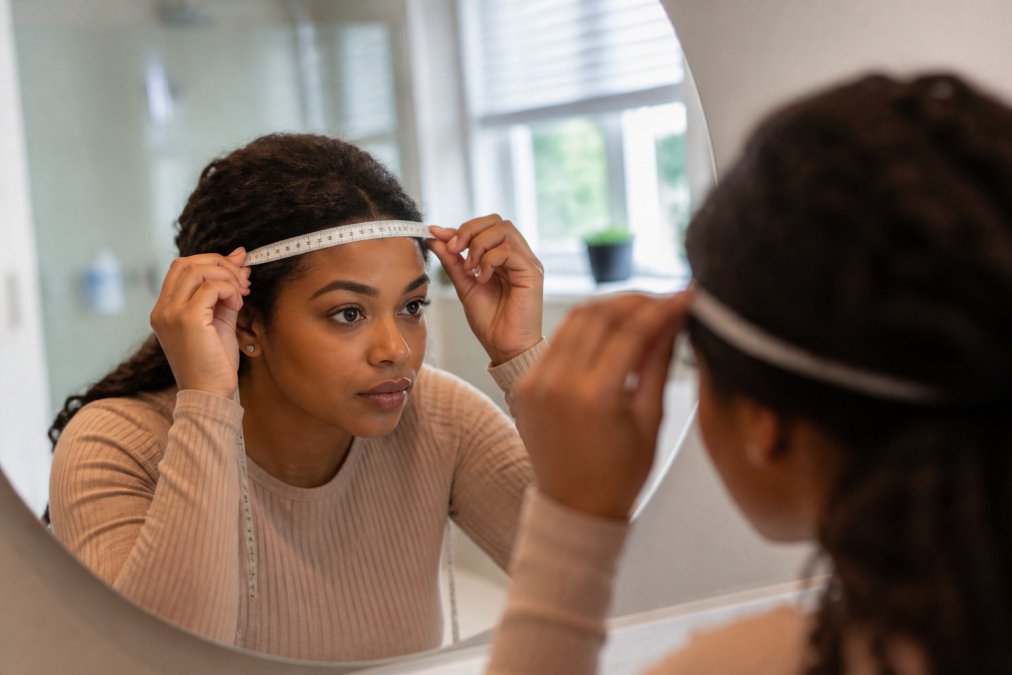
Step 1: Find the Hairline and Nape
Start by identifying your natural hairline at the front and the nape of your neck at the back. Comb all hair away from your face and neck. The front hairline sits where your forehead meets your hair growth, usually about 7 to 8 centimetres above your eyebrows (peer-reviewed research). The nape is the bony bump at the base of your skull where your neck begins.
Step 2: Measure the Circumference
Wrap the tape measure around your head, starting at the centre of your front hairline. Bring it around your head just above your ears and over the occipital bone at the back, which is the prominent curve at the base of your skull. This is the most important measurement for wig sizing and corresponds directly to the cap size in most wig size charts.
Step 3: Measure Front to Nape
Place the end of the tape at the centre of your front hairline. Run it over the top of your head, following the natural curve of your skull, down to the centre of your nape. Keep the tape centred and avoid pulling it to either side, as this distorts the reading.
Step 4: Measure Ear to Ear Across the Forehead
Position the tape just above one ear, at the point where your ear meets your head. Guide it across your forehead, passing over the highest point of your brow, and stop at the same spot above your opposite ear. This measurement determines how the wig sits across the front of your head.
Step 5: Measure Ear to Ear Over the Top
From the same starting point above one ear, run the tape over the crown of your head to the corresponding point above your other ear. This reading captures the depth of your head from side to side and is essential for wigs with a defined parting.
Step 6: Measure the Temple to Temple
Place the tape at one temple, roughly level with the outer corner of your eye. Measure across your forehead to the temple on the other side. This is a shorter measurement that helps determine how the wig frames your face and whether the front lace or fringe will sit correctly.
Step 7: Measure the Nape to Nape
Finally, measure the distance across the back of your head from one side of your nape to the other. This ensures the back of the wig covers your natural hair completely and sits comfortably against your neck.
Wig Size Chart: Matching Your Measurements
Once you have all seven figures, compare them against a standard wig size chart to find your cap size. Most manufacturers, including Wigs Ldn, use the circumference measurement as the primary indicator.
| Cap Size | Circumference | Best Fit For |
|---|---|---|
| Petite | Under 53 cm | Smaller head shapes, often with a narrower nape |
| Average | 53 - 55 cm | The most common size for adult women |
| Large | 56 - 58 cm | Fuller head shapes or those with thick natural hair |
| Extra Large | Over 58 cm | Broader head shapes requiring additional room |
If your circumference sits on the boundary between two sizes, consider the other measurements. A larger front-to-nape distance with an average circumference might indicate a deeper head shape, which some caps accommodate better than others. When ordering a made-to-order wig, you can provide all seven measurements so the cap is tailored precisely to you.
How to Measure Head for Wig With Hair
Measuring your head with natural hair present requires a small adjustment. Thick, voluminous hair can add several millimetres to your readings, which means your wig may arrive looser than intended.
The solution is to flatten your hair as much as possible before measuring. If you have longer hair, pull it back into a low ponytail or braid that sits at the nape. For shorter or finer hair, use a wig cap or a tight stocking cap to compress your hair against your scalp. If you have very thick hair, consider having a friend help you hold the tape level while you manage your hair out of the way.
Common Measuring Mistakes to Avoid
Several recurring errors lead to poor wig fits, even when the buyer follows the steps carefully.
The most common is pulling the tape too tight (the American Academy of Dermatology). The tape should rest against your head with light contact, not compress the skin. Tight measurements produce a cap that feels restrictive and causes headaches during wear.
Another frequent error is measuring at the wrong vertical position. The circumference must pass over the occipital bone at the back, not higher up on the crown. If the tape rides too high, the wig will sit too far forward or backward on your head.
Finally, do not rely on a single measurement. Your head is not a perfect circle, and two people with the same circumference can have completely different head shapes. The ear-to-ear and front-to-nape measurements catch these variations, which is why made-to-order services request the full set.
Getting the Perfect Fit With Wigs Ldn
A precise measurement transforms a wig from a temporary accessory into a seamless extension of your appearance. Once you know your numbers, ordering a wig that fits becomes straightforward, and you can shop with confidence rather than hoping for the best.
At Wigs Ldn, every wig is made to order in the UK, which means your measurements are built into the cap from the start rather than approximated from a generic template. Our glueless designs rely on a secure, accurate fit to stay in place throughout the day without slipping, which makes your measurements even more critical. We also offer a 30-day money-back guarantee, giving you peace of mind if the fit is not quite right when your wig arrives.
Take ten minutes today to measure your head properly. It is the difference between a wig you can forget you are wearing and one you adjust constantly. Explore our range of handcrafted human hair wigs at Wigs Ldn and find a piece that fits as beautifully as it looks.
Frequently Asked Questions
What are the standard wig cap sizes?
Most wigs come in three standard sizes: petite (around 54 cm), average (around 56 cm), and large (around 58 cm). These numbers refer to the circumference of the cap. Use a wig size chart to compare your own measurements against these standards. If you fall between sizes, choosing the larger size is often safer, as a wig that is too small can cause headaches and discomfort.
Do I need to flatten my hair before measuring for a wig?
Yes, you should measure over your natural hair as flat as possible. If you have thick or voluminous hair, braid it close to the scalp or wear a wig cap. This ensures your measurements reflect your head size, not the bulk of your hair. For those with thinning hair or alopecia, measuring directly on the scalp is fine and provides the most accurate result.
What happens if my head measurements fall between wig sizes?
If your measurements fall between standard sizes, it is generally better to opt for the larger size. A slightly larger wig can be adjusted with clips or by a professional to ensure a snug fit. A wig that is too small will be uncomfortable and may cause tension headaches. For a made-to-order wig, you can provide your exact measurements for a bespoke fit.
How do I know if a wig fits correctly?
A correctly fitted wig should feel snug but not tight. You should be able to place one finger comfortably between the wig band and your scalp. The front hairline should sit at your natural hairline, and the wig should not shift or slide when you move your head. The ear tabs should lie flat against the sides of your head, just in front of your ears.
This article was written using GrandRanker