

Table of Contents
- Why Cheap Wigs Look Shiny: The Materials Behind the Glare
- How to Make a Synthetic Wig Look Less Shiny
- How to Make a Wig Look More Natural
- Human Hair Wigs vs Synthetic Wigs: What the Difference Means for Shine
- How to Wash a Synthetic Wig Without Adding Shine
- When to Replace a Shiny Wig With a Natural-Looking Alternative
- Conclusion: Choosing a Wig That Looks Natural From Day One
- Frequently Asked Questions
Last Updated: October 9, 2026
Why Cheap Wigs Look Shiny: The Materials Behind the Glare
If you have ever wondered why cheap wigs look shiny, the answer sits in the fibre itself. Most budget wigs are made from low-grade synthetic plastic, and plastic reflects light the way a window does. At Wigs Ldn, we hear this complaint constantly from women who bought a wig online, loved it for a week, then caught their reflection in daylight and felt instantly self-conscious.
Here is the short version: real hair has a rough, layered surface that scatters light in every direction. Cheap synthetic fibre has a smooth, uniform surface that bounces light straight back at whoever is looking. That bounce is the glare. It is not a styling problem, and no amount of brushing will fix it.
Below, we explain exactly what causes the shine, how to tone it down if you already own a shiny wig, and when it is simply time to replace it.
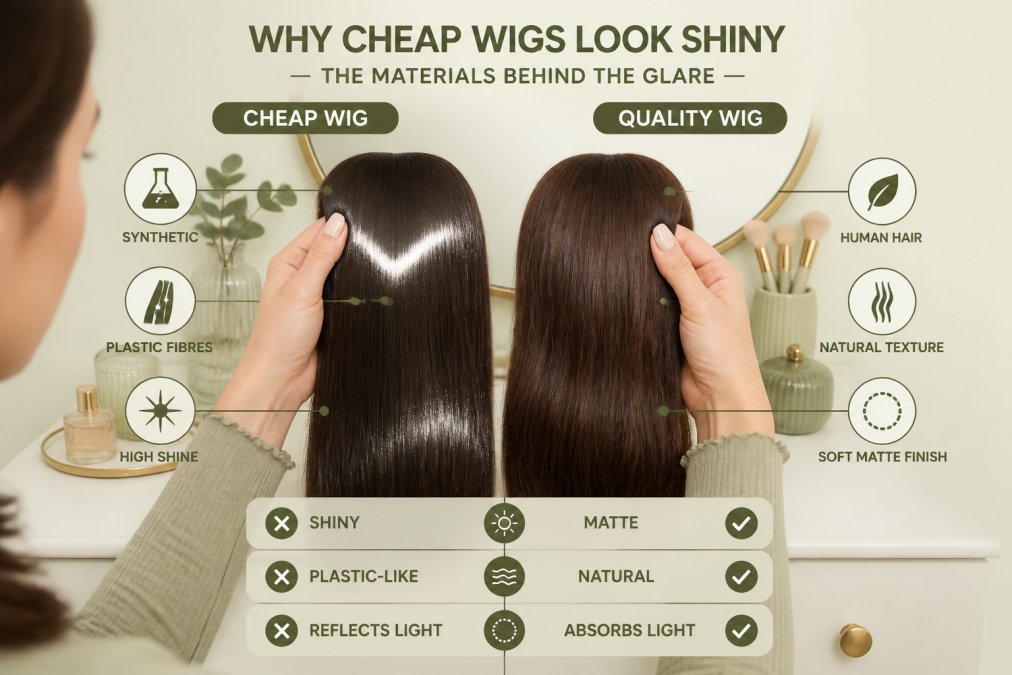
Low-grade synthetic fibres and their reflective finish
Budget wigs usually use a fibre type the trade calls "basic" or "standard" synthetic. It is made from the same family of plastics used in cheap packaging, and it is extruded into strands at high speed. Fast extrusion leaves the strand surface glassy and perfectly even.
Real hair is not even. Each strand has an outer layer of overlapping scales, like roof tiles. Those scales break up light. Plastic strands have no scales at all, so light hits them and leaves in one clean bounce.
There is a second issue too. Cheap fibres are often finished with a silicone coating to stop tangling during shipping. That coating adds extra gloss. It also attracts dust, which makes the shine look duller and dirtier over time.
How manufacturing shortcuts create an artificial sheen
Speed and cost drive every decision in mass production. Factories skip the finishing steps that make fibre look softer and less reflective, because each step adds time and money.
The shortcuts that matter most:
- No texturising step. Premium fibre gets a treatment that roughens the surface. Cheap fibre skips it.
- Heavy silicone coating. A quick dip adds slip and shine in one pass.
- Machine-sewn wefts packed too tightly. Dense rows of shiny fibre reflect light as one solid sheet.
- No colour blending. Single-tone fibre reads as flat and artificial next to multi-tonal real hair.
The result is a wig that looks fine in a dim shop mirror and obvious in daylight. That gap between indoor and outdoor lighting catches almost everyone out.
How to Make a Synthetic Wig Look Less Shiny
You can reduce shine on a synthetic wig in about ten minutes using powder. The principle is simple: powder roughens the surface of the fibre, so light scatters instead of bouncing. It is the same reason matte lipstick looks less glossy than a satin finish.
Dry shampoo and powder techniques that actually work
Dry shampoo is the most common fix, and it does work, but only if you apply it properly. Most people spray too much in one spot and end up with grey patches.
A method that works reliably:
- Turn the wig inside out and place it on a stand or a towel.
- Hold the can 30 cm away and mist in short bursts, not one long spray.
- Focus on the mid-lengths and ends, not the roots or the parting.
- Wait two minutes, then brush through gently with a wide-tooth comb.
- Check in daylight, not bathroom light, before adding more.
Loose setting powder works the same way and gives you more control. Tap a small amount onto a makeup brush, then dust it down the length of the wig. Translucent powder suits most fibre colours because it does not shift the tone.
A few things to avoid:
- Do not use talcum powder near the parting, as it can look chalky against the scalp.
- Do not apply powder to a wet wig, as it will clump.
- Do not use hairspray to "set" the powder, as it adds shine back.
How to Make a Wig Look More Natural
Making a wig look natural comes down to three things: less shine, a believable hairline, and a colour that matches your skin tone rather than fighting it. Shine is the loudest signal, but the parting and the density matter almost as much.
Start with the parting. A sharp, straight line of fibre across the top of the head reads as a wig instantly. Real partings are slightly irregular, with a bit of scalp visible. If your wig has a lace front, you can soften the parting with a little powder along the line.
Density is the second tell. Cheap wigs are often far too thick, because thin fibre looks sparse and factories avoid complaints by overfilling. Real hair thins toward the ends. If your wig is very dense at the tips, a stylist can thin it out with thinning scissors.
Colour is the third. A jet-black wig on someone with a warm, light complexion looks harsh. Choose a shade one or two steps softer than your natural colour, and look for wigs with more than one tone running through the fibre.
Quick checklist for a more natural finish:
- Powder applied to mid-lengths and ends
- Parting softened, not razor-sharp
- Density thinned at the tips if the wig looks bulky
- Colour matched to skin undertone, not just to a photo
- Hairline trimmed to sit slightly forward of your own
Human Hair Wigs vs Synthetic Wigs: What the Difference Means for Shine
The core difference is that human hair has a cuticle and synthetic fibre does not. That single fact explains almost everything about how each type looks, behaves and ages.
Human hair reflects light softly because its cuticle scatters it. It also absorbs moisture and oils from your scalp, which keeps it looking lived-in. Synthetic fibre cannot absorb anything, so it stays glossy and dry-looking unless you add product.
| Feature | Human Hair Wig | Synthetic Wig |
|---|---|---|
| Surface | Layered cuticle, soft light reflection | Smooth plastic, sharp reflection |
| Shine level | Low to medium, natural | High, especially in daylight |
| Styling with heat | Yes, with care | No, unless heat-friendly fibre |
| Colour options | Can be dyed and toned | Fixed at purchase |
| Lifespan | Longer with good care | Shorter, tends to dull and tangle |
| Best for | Daily wear, natural look | Occasional wear, lower budget |
Synthetic wigs do have real advantages. They hold a style without any effort, they cost less, and they are ready to wear straight out of the box. If you only need a wig for a few events a year, synthetic can be a sensible choice.
For daily wear, though, human hair wins on the one thing that matters most: it does not glare. That is the honest trade-off.
How to Wash a Synthetic Wig Without Adding Shine
Washing a synthetic wig without adding shine means using cool water and the right product, then drying it flat. Heat and harsh detergent are what turn a dull wig glossy again.
Follow this order:
- Fill a basin with cool water. Warm water distorts the fibre.
- Add a small amount of gentle shampoo made for synthetic wigs. Regular shampoo strips the fibre.
- Dip and squeeze the wig through the water. Do not scrub or bunch it.
- Rinse in cool water until the water runs clear.
- Blot with a towel, never wring.
- Leave to air-dry on a stand away from radiators and direct sun.
- Reapply powder once fully dry if shine returns.
A common mistake is brushing a wet synthetic wig. Wet fibre stretches, and brushing pulls the style out of shape permanently.
When to Replace a Shiny Wig With a Natural-Looking Alternative
Replace a shiny wig when powder no longer helps, when the fibre starts tangling within minutes of brushing, or when the ends look frizzy and dry. Those are signs the fibre itself has broken down, and no treatment will bring it back.
Cheap synthetic wigs typically have a short working life. They dull, tangle and shed, and the shine often returns worse after each wash. If you wear a wig daily, you will hit that wall sooner than you expect.
There is also a comfort issue. Mass-produced wigs are built to a standard head size, so they can slip, dig in, or sit slightly off. For anyone dealing with hair loss or alopecia, a wig that shifts during the day is more than an annoyance. It undermines confidence.
This is where made-to-order changes the experience. At Wigs Ldn, every piece is handcrafted to order, which means the cap fits your head. Our glueless designs stay secure without adhesive, so there is no slipping and no daily glue routine. You can also choose the texture and colour, so the result matches your skin tone instead of sitting on top of it.
If you are weighing up your options, our team can talk you through what suits your hair loss pattern and lifestyle. Pricing depends on the specification, length and delivery timeline, so the best next step is to check our site for current details and a quote.
Conclusion: Choosing a Wig That Looks Natural From Day One
Shine is the fastest way to spot a cheap wig, and it comes down to plastic fibre with no cuticle to scatter light. Powder and careful washing can buy you time, but they cannot change what the fibre is made of.
If you want a wig that looks natural without a daily routine of fixes, the answer is the fibre and the fit. Wigs Ldn makes handcrafted human hair wigs to order, with glueless options that stay put, custom textures and colours, and a 30-day money-back guarantee. Get started with Wigs Ldn and wear your hair with confidence from the first day.
Frequently Asked Questions
Why do cheap wigs look so shiny?
Cheap wigs are usually made from low-grade synthetic fibres that have a smooth, plastic-like surface. This surface reflects light directly rather than scattering it the way natural hair does. Manufacturers also apply a silicone coating during production to make the fibres feel softer, which adds to the glare. Combined with fewer strands and a coarser fibre texture, the result is a uniform, artificial shine that reads as 'wig' rather than natural hair.
Are synthetic wigs always shinier than human hair wigs?
Not always, but the majority are. Human hair has a cuticle layer that diffuses light naturally, giving it a soft, varied reflection. Standard synthetic fibres lack this structure, so light bounces off in a flatter, more concentrated way. Higher-quality synthetic wigs use matte or heat-friendly fibres that reduce this effect, but they still tend to shine more than a well-made human hair wig, especially under bright or direct lighting.
Does washing a synthetic wig reduce its shine?
Washing can help, but only if you use the right method. Use cool water and a gentle synthetic wig shampoo, then rinse thoroughly. Avoid hot water, which can damage the fibres and increase shine. After washing, pat dry with a towel and let it air dry on a wig stand. Applying a light dusting of dry shampoo or translucent powder after drying can further reduce shine. Never brush a synthetic wig while wet, as this can stretch and distort the fibres.
How can I tell whether a wig will look natural before buying it?
Check the fibre type first. Wigs labelled as heat-friendly or matte synthetic tend to look more natural than standard synthetic options. Look at the lace front or parting area: a realistic scalp appearance is a strong indicator of quality. If possible, view the wig under natural daylight rather than studio lighting, as bright shop lights can mask or exaggerate shine. Ask whether the wig is made to order.