

Last Updated: October 30, 2026
Quick Summary
The best brushes for human hair wigs are a soft cushion paddle brush for straight and wavy wigs and a wide-tooth comb for curly wigs. Brush from the ends upwards, mist the wig lightly first, and clean the brush weekly to keep the brushes for human hair wigs in good condition.
- Use a soft cushion paddle brush with rounded tips for straight and wavy wigs.
- Choose a wide-tooth comb or detangling brush first for curly and coily wigs.
- Keep bristle spacing about 3 to 5 mm apart for fine, straight hair.
- Brush in sections of about 5 cm, working from the ends up to the roots.
- Wash the brush weekly, dry it bristle-side down, and replace it when tips lose smoothness.
Table of Contents
- Why the Right Brush Matters for a Human Hair Wig
- How to Choose a Brush for Your Wig's Texture and Length
- Paddle Brush for Wigs: When It Works Best
- Wide-Tooth Comb for Wigs: Detangling Without Breakage
- Brush for Curly Wigs and Wavy Wigs
- How to Brush a Wig Step by Step
- Cleaning Your Brush and Keeping Your Wig in Good Condition
- Book a Consultation to Find Your Wig's Ideal Care Routine
- Frequently Asked Questions
Choosing the right brush can make or break how your human hair wig looks and lasts, and the choice of brushes for human hair wigs is one of the most overlooked parts of wig care. A wrong brush can snag, frizz and slowly shorten a wig's life. At Wigs Ldn, we handcraft human hair wigs in the UK. This guide explains what to look for, which brush suits which texture, and how to brush and clean your wig safely. Keep reading for a clear buyer's guide to the best brushes for human hair wigs.
Why the Right Brush Matters for a Human Hair Wig
Human hair wigs behave like real hair. They tangle, dry out and lose their shape when handled roughly.
The right brush does three things well. It separates hair gently, it distributes natural oils or conditioner evenly, and it keeps the ends intact. A wig that is brushed correctly keeps its movement and its natural sheen for longer.
Watch out: brushing a dry wig with a stiff, cheap brush is the fastest way to create tangles at the nape and ends.
How to Choose a Brush for Your Wig's Texture and Length
Choosing between a paddle, a vented cushion brush, a detangling brush and a wide-tooth comb depends on three variables: texture, length and cap construction. Work through them in that order.
Match the brush to the texture
- Straight wigs: a flat paddle brush with soft, rounded nylon bristles and a cushioned base glides through lengths without dragging. Look for bristles spaced about 3-5 mm apart; tighter spacing creates friction on fine hair. A vented brush is a good second option for blow-drying because air passes through the head.
- Wavy wigs: a soft bristle brush or a small vented brush smooths the outer layer while leaving the wave pattern intact. Avoid stiff boar-bristle brushes, which can flatten waves into a straight, lifeless finish.
- Curly and coily wigs: finger-detangle first, then use a wide-tooth comb or a dedicated detangling brush with flexible, staggered teeth. A paddle brush on dry curls will break the pattern and create frizz. If you want definition, a curl-specific brush with widely spaced, rounded pins is the safer choice.
- Fine or thinning human hair: a soft bristle brush or a small cushion brush with gentle nylon pins. Stiff bristles on fine hair cause breakage at the ends within a few weeks of daily use.
Adjust for length
- Short wigs (bob length and above): a small cushion brush or a wide-tooth comb is easier to control and less likely to catch the nape.
- Shoulder-length to mid-back: a standard paddle brush or a detangling brush with flexible teeth. Work in sections no wider than the brush head.
- Long wigs (below mid-back): a wide paddle brush with a cushioned base and flexible bristles, plus a wide-tooth comb for the ends. Long human hair wigs tangle most at the last 10-15 cm, so detangle that section first before brushing from the mid-lengths up.
Check the construction
- Bristle tips: ball-tipped or rounded ends prevent scratching the wig cap and the lace front. Avoid cut nylon bristles with sharp ends.
- Bristle spacing: wider spacing (roughly 4-6 mm) suits thick or curly hair; tighter spacing suits fine, straight hair but increases snagging risk if the tips are not rounded.
- Cushion base: an air-cushion base lets the bristles flex independently, which reduces pulling. A rigid base transfers force straight to the knot.
- Vented back: useful for drying and for distributing light conditioning mists evenly.
- Handle: a lightweight, non-slip handle matters more than most buyers expect, because you will be brushing in small sections on a wig stand rather than in one quick pass.
Quick texture-to-tool guide
| Wig texture | First tool | Second tool | Avoid |
|---|---|---|---|
| Straight, fine | Soft cushion paddle brush | Wide-tooth comb | Stiff boar bristle, fine metal combs |
| Straight, thick | Vented paddle brush | Detangling brush | Tightly spaced stiff bristles |
| Wavy | Soft bristle brush | Wide-tooth comb | Stiff paddle on dry hair |
| Curly/coily | Wide-tooth comb or detangling brush | Finger detangling | Paddle brush on dry curls |
| Long (any texture) | Wide paddle brush | Wide-tooth comb for ends | Small round brushes |
The best brush is often a small set matched to how your wig is constructed and worn, rather than a single product.
Paddle Brush for Wigs: When It Works Best
A paddle brush has a flat, wide head and is ideal for smoothing long, straight wigs. It spreads product evenly and gives a glossy finish. Paddle brushes suit wigs that are already detangled and need styling.
They are less suitable for tangled or heavily curled wigs. A paddle brush can drag through knots and cause breakage if you start at the roots. Always detangle first with a gentler tool, then finish with the paddle.
A common mistake is brushing the whole length in one pass. Work from the ends upwards, in small sections, to keep the hair intact.
Wide-Tooth Comb for Wigs: Detangling Without Breakage
A wide-tooth comb is often the safest first tool for a human hair wig. Its gaps are wide enough to glide through knots without catching the cuticle. It is the go-to choice for wet detangling and for wigs that have been stored.
Hold the wig firmly on a wig stand, then work from the ends up to the roots. Never comb from the crown down through a tangle, as this pulls knots tighter.
Watch out: metal combs with fine teeth can snag human hair and should be avoided on wet or conditioned wigs.
Brush for Curly Wigs and Wavy Wigs
Curly and wavy wigs need a different approach. Brushing a dry curl can create frizz and destroy the pattern. Many people prefer to use their fingers or a wide-tooth comb on curls, then a soft brush only to shape the outer layer.
For wavy wigs, a soft bristle brush can smooth flyaways while keeping the wave intact. Use a light spray of water or leave-in conditioner first, then brush gently from the ends.
Curls benefit from being separated by hand before any brush touches them. This keeps the pattern defined and reduces frizz.
How to Brush a Wig Step by Step
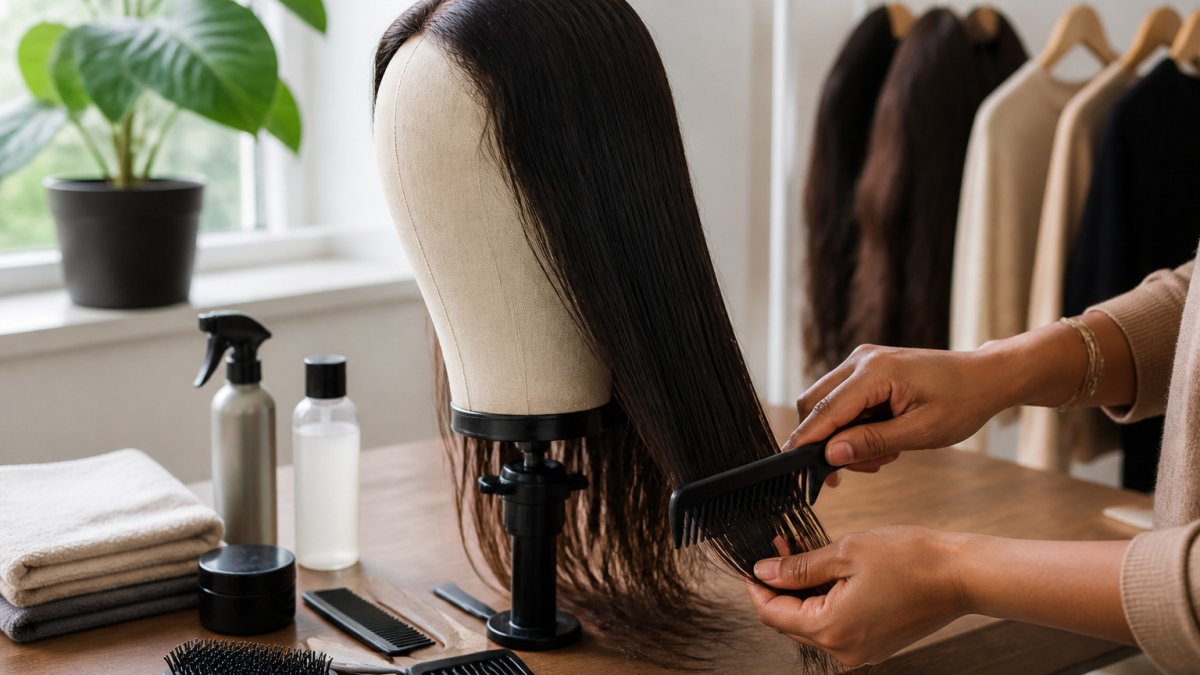
- Secure the wig on a foam or stand wig head so it stays still.
- Mist lightly with water or a leave-in conditioner made for human hair.
- Start at the ends and work up in small sections, about 5 cm at a time.
- Use a wide-tooth comb to detangle any knots before using a brush.
- Brush gently with a soft bristle or paddle brush, using short, smooth strokes.
- Finish with a light pass over the crown and top, avoiding the lace or cap edges.
Expected result: smooth, tangle-free lengths with natural movement and no visible breakage.
Cleaning Your Brush and Keeping Your Wig in Good Condition
Brush hygiene is an important part of wig care. A brush that looks clean can still hold shed hair, sebum, styling product and conditioner residue in the base of the bristles. Every time you brush, that residue transfers back into the wig, dulling the cuticle and making tangles more likely. For more on this, see how to maintain hair shine naturally at home. Cleaning your brush properly is therefore part of protecting the wig, not a separate chore.
How often to clean
- Daily brushing: remove loose hair from the bristles after every use. This takes about 30 seconds and prevents the base from clogging.
- Weekly: wash the brush if you style or mist the wig most days.
- Fortnightly: a minimum for occasional wear.
- After heavy product use: wash the same day. Leave-in conditioner, serum and dry shampoo all leave film on bristles.
Step-by-step brush cleaning
- Remove shed hair. Use a wide-tooth comb or a tail comb to lift hair out of the bristles, working from the base upwards. Do not pull hair sideways through the bristles, as this can bend the pins.
- Fill a basin with lukewarm water, not hot, which can warp a cushion base or loosen glued bristles.
- Add a small amount of mild shampoo or a gentle soap. Avoid harsh detergents and fabric softener.
- Swirl the brush head in the water for 30-60 seconds. Do not scrub the bristles against the basin, which bends the tips.
- Rinse under running lukewarm water until the water runs clear.
- Shake off excess water and blot the base with a towel.
- Dry bristle-side down on a towel, ideally propped so air reaches the base. Do not stand the brush upright while wet, as water can seep into the cushion and loosen the bristles or encourage mould.
Signs it is time to replace a brush
- Bristle tips have become sharp or bent.
- The cushion base has hardened or cracked.
- Bristles are shedding into the wig.
- The brush no longer glides and catches at the ends even after cleaning.
Replace a brush when its tips lose their smoothness or it begins to shed into the wig.
Keeping the wig itself in good condition
Brush cleaning sits alongside three other habits that protect human hair wigs:
- Store on a wig stand or in a breathable bag away from direct sunlight and radiators. Heat and UV dry out the cuticle.
- Mist lightly before brushing rather than brushing a bone-dry wig, which increases friction and static.
- Wash the wig on a schedule that suits how often it is worn, using a gentle shampoo and a light conditioner on the lengths only.
A clean brush, a light mist and a stand are simple ways to help look after a human hair wig.
Book a Consultation to Find Your Wig's Ideal Care Routine
Every wig is different, and the best brush for your wig depends on its texture, length and construction. If you are unsure which tool suits your piece, our team can help you build a routine that fits.
Get in touch with Wigs Ldn to find out more about caring for your wig.
Frequently Asked Questions
What brush is best for a human hair wig?
A paddle brush or a wide-tooth comb is usually the safest choice for a human hair wig. Both separate hair gently without pulling at the base. Choose a paddle brush with rounded, flexible bristles for smoothing and a wide-tooth comb for detangling knots, especially when the wig is damp. Avoid fine-tooth combs and wire brushes, which can snag and cause breakage over time.
Can you use a normal hairbrush on a human hair wig?
A standard hairbrush with tightly packed bristles can catch on the wig's wefts and pull at the cap. It can also cause the hair to tangle more. A brush with ball-tipped or rounded bristles and a wide spacing is kinder to the hair. If you only have a regular brush, start from the ends and work upwards slowly, holding the wig firmly at the base.
Should you brush a human hair wig when it is wet?
Brushing a wet wig is generally not recommended, because wet hair is more elastic and prone to breakage. Let the wig air-dry on a wig stand first. Once it is mostly dry, you can use a wide-tooth comb or a soft paddle brush to remove any remaining tangles. Always work in small sections, beginning at the ends.
How often should you brush a human hair wig?
Brush the wig before and after wearing it, and give it a gentle brush once or twice a week if it is worn daily. Over-brushing can weaken the fibres and cause frizz, so avoid brushing more than necessary. Use a light touch and only detangle the sections that need it, keeping the wig's style and natural movement intact.
