

Last Updated: 20 November 2026
Quick Summary
Lightweight wigs for low density hair are built with less hair per square centimetre, so they sit closer to the head and mimic the natural density of fine or thinning hair. Match the density to the coverage you had, not the volume you wish you had, and ask for the finished weight in grams before you order.
- Density is the main driver of wig weight, so dropping it is the most effective change you can make.
- Ask what the finished piece weighs in grams, not just the hair length.
- Graduated density, fuller at the crown, lighter at the hairline and nape, looks more natural than one uniform density.
- Short and medium styles suit low density best, because length adds weight and pulls hair flat at the crown.
- Pieces start from £170 and come with a 30-day money-back guarantee and free worldwide delivery.
Table of Contents
- What Low-Density Wigs Are and Why They Suit Fine Hair
- Why Lightweight Wigs for Thinning Hair Feel Better All Day
- Low-Density Wigs for Fine Hair: Matching Density to Your Own Coverage
- Low-Density Human Hair Wigs Compared with Synthetic Options
- Wig Cap Construction for Comfort and a Realistic Parting
- Choosing Your Style: Bob, Pixie, Layers and Length
- Styling and Caring for a Low-Density Wig
- Ordering a Made-to-Order Wig from Wigs Ldn
- Frequently Asked Questions
What Low-Density Wigs Are and Why They Suit Fine Hair
A low-density wig is built with less hair per square centimetre than a standard unit, so it sits closer to the head and mimics the natural density of fine or thinning hair.
Fine hair shows the scalp more readily, and a dense wig covers that with a solid wall of hair that reads as a helmet.
If your thinning is still early and localised, you may not need a full wig at all. Our guide to hair toppers vs wigs for early thinning hair explains when a topper does the job and when a full piece is the better choice.
Why Lightweight Wigs for Thinning Hair Feel Better All Day
Lightweight wigs for thinning hair feel better because there is less hair to carry, less heat trapped against the scalp, and less weight pulling on the cap edges. Density is the main driver of weight, so dropping it is the single most effective change you can make.
Weight, Breathability and Warm Weather Comfort
Warm weather is where dense wigs fail: a heavy unit holds heat at the crown and nape and the scalp cannot breathe. A lighter piece with an open cap lets air move, which matters if you wear your wig for a full working day.
Three practical points we would raise before you buy:
- Ask what the finished piece weighs, not just the hair length
- Check whether the cap has open webbing or closed sections at the crown
- Plan for a lighter density in summer and a slightly fuller one in winter if you wear daily
The NHS information on hair loss is a useful starting point if you are still working out why your hair is thinning before you choose a piece.
Low-Density Wigs for Fine Hair: Matching Density to Your Own Coverage
Matching density to your own coverage is the step most buyers skip, and it is the one that decides whether a wig looks natural. The rule we use is simple: match the wig to the density you had, not the density you wish you had. But how do you actually assess that? Here is the practical method we take customers through before any made-to-order piece is specified.
Step 1: Assess your own density in daylight
Stand in good, indirect daylight facing a mirror, with your hair parted as you normally wear it. Look at the parting, front hairline and crown, and note how much scalp is visible in each. A clear line of scalp at the parting suggests a light-density piece with a defined parting; if scalp barely shows, a slightly fuller low-density piece looks more believable.
A useful check is to compare against an old photograph from before your thinning became noticeable.
Step 2: Match density zone by zone, not head-wide
Real hair is denser at the crown and lighter at the front, edges and parting. Ordering the same density across the whole head produces a flat, uniform look no natural head of hair has. Ask for graduated density, fuller through the crown, lighter at the hairline and nape.
Step 3: Account for your level of hair loss
Use this as a rough guide, not a rule:
- Early thinning, scalp visible mainly at the parting: a light-density piece with a lace or monofilament parting will blend best. You may not need a full wig at all, a topper can be the better first step.
- Moderate thinning across the top: a low-density full wig with graduated density and a realistic parting gives coverage without bulk.
- Significant loss or a fully exposed scalp: a low-density piece still works, but the cap becomes the deciding factor. Choose a cap with a realistic scalp section at the parting and hairline, because there is less hair to disguise the cap.
Step 4: Check the density against the style
Density and style interact. A pixie at very low density looks convincing; the same density in a long, blunt cut can look sparse at the ends. If you want length, ask for a lighter density through the length to compensate for the extra weight, and keep the ends softly layered rather than blunt.
Step 5: Confirm the finished weight before you order
Density drives weight, but cap construction and length also contribute. Ask for the finished weight in grams, not just the hair length, a piece that feels right on paper can still be too heavy by mid-afternoon if the cap is closed and the length is long. If you wear daily, this is the single most useful number to request.
For a deeper look at density options, our guide on choosing wig density for a natural look walks through the grades. If your thinning is early and localised, our guide to hair toppers vs wigs for early thinning hair explains when a topper does the job and when a full piece is better.
Low-Density Human Hair Wigs Compared with Synthetic Options
Human hair moves like hair, takes heat styling, can be recoloured, and settles into your own texture over time. Heat-friendly synthetic can be styled with low heat and holds a set well, but it keeps its shape rather than relaxing and has a shorter useful life.
| Feature | Human hair | Heat-friendly synthetic |
|---|---|---|
| Movement and fall | Natural, weighted | Holds shape, stiffer |
| Heat styling | Straighten and curl freely | Low heat only |
| Colouring | Can be recoloured | Not recommended |
| Lifespan | Longer with good care | Shorter, replaces sooner |
| Best for | Daily wear, sensitive scalps | Occasional wear, set styles |
Wig Cap Construction for Comfort and a Realistic Parting
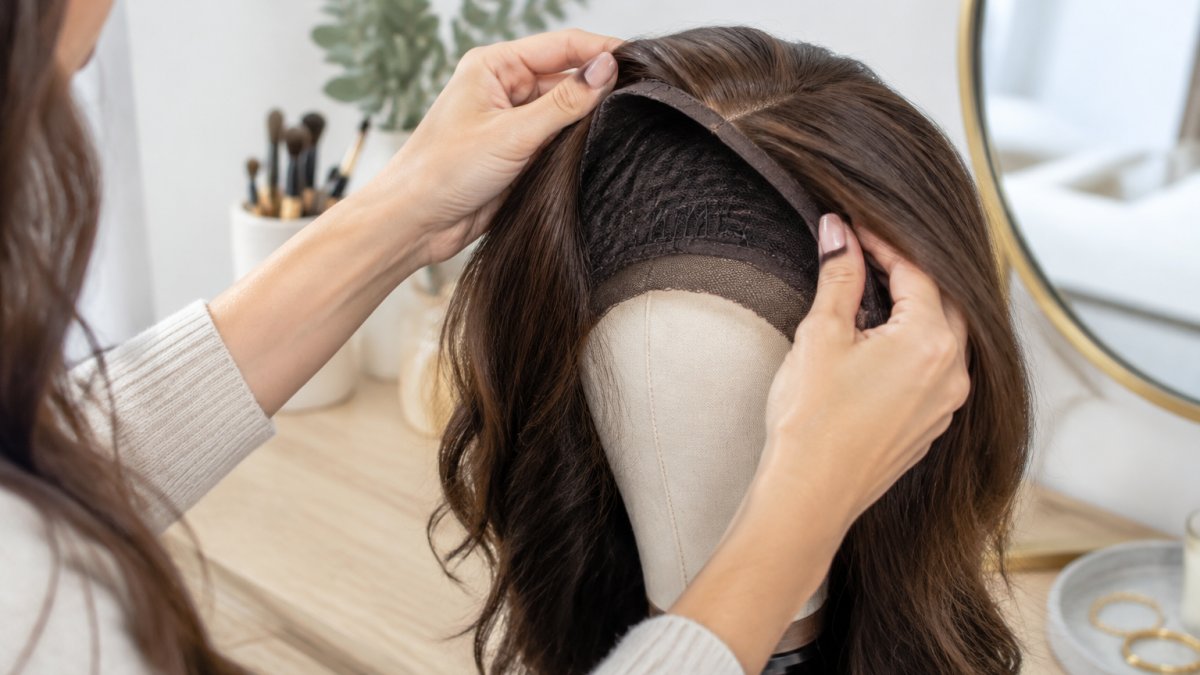
Cap construction decides both comfort and how real the parting looks. A low-density wig has less hair to hide the cap, so the cap has to do more of the work, at standard density hair covers most shortcomings, but at low density every knot, seam and closure is closer to visible.
The main cap types and what they do
- Standard wefted cap: open webbing with hair sewn in rows. It is the lightest and most breathable option, and the cheapest to make. The trade-off is that the parting is not realistic, you see the weft rows rather than scalp, so it suits styles worn with a fringe or a side sweep that covers the parting.
- Lace front: a fine mesh at the front hairline that individual hairs are knotted through. It gives a realistic hairline and allows a parting at the front, but the lace needs careful handling and can be delicate. At low density, a lace front is often the difference between a convincing hairline and an obvious edge.
- Monofilament top or parting: a fine, transparent mesh through which your own scalp colour shows. It gives the most realistic parting and crown because there are no wefts or knots visible, and it allows multi-directional styling. It is less breathable than open webbing and adds a little weight, so it suits wearers who prioritise naturalness over maximum airflow.
- Closed or skin-top sections: a solid section that mimics scalp most closely. It is the most realistic at the parting but the least breathable, and it can feel warm on a sensitive scalp. Best for short wear or cooler conditions.
Matching the cap to your priorities
There is no single best cap, only the best cap for your priorities. If breathability and lightness come first, say, all-day wear in a warm office, an open webbed cap with a lace front gives the best balance. If a realistic parting is the main concern, a monofilament parting or lace front is worth the small weight penalty.
Fit, pressure points and sensitive scalps
Stretch panels at the sides and nape keep the fit secure without pressure points. Adjustable straps and silicone or velvet grip bands hold better than tight elastic on fine, slippery hair, which lets a tight cap slide forward. Glueless designs avoid adhesive entirely, suiting anyone whose scalp reacts to glue or who wants easy removal at night. If measuring at home, measure the circumference at the hairline, then front-to-nape and ear-to-ear, and compare against the maker's size chart.
Securing a wig on fine or slippery hair
If a natural-looking scalp is your main concern, our guide to the natural scalp looking wig cap covers cap types and parting realism in more depth.
Choosing Your Style: Bob, Pixie, Layers and Length
Short and medium styles suit low density best, because length adds weight and pulls the hair flat at the crown. A bob or lightly layered medium cut keeps movement without needing bulk.
- Pixie cut: the most convincing option at very low density, and the easiest to keep looking neat
- Bob: a chin or jaw-length bob holds shape well and frames the face
- Lightly layered medium-length: adds soft movement, best with soft waves rather than a blunt finish
- Long style: possible, but ask for a lighter density to compensate for the length
Texture and colour do a lot of the work: soft waves read as more natural than a flat, straight finish at low density, and a colour close to your own roots hides the hairline better than a high-contrast shade.
Face shape should guide the final call. Our guide on choosing wig style for face shape breaks down which shapes suit which features.
Styling and Caring for a Low-Density Wig
A few habits that keep a light piece looking fresh:
- Store it on a stand to hold the shape and protect the parting
- Keep heat tools on a low setting, especially near the front hairline
- Avoid heavy styling products, which clump thin sections together
- Let it dry naturally where you can, rather than blasting it with heat
Ordering a Made-to-Order Wig from Wigs Ldn
Made-to-order is the right route when density, cap and colour all have to line up, which is exactly the case with low-density pieces. Every wig we make is built to order here in the UK.
If you want a piece built around your own hairline and colour, our custom made human wigs service is where to start.
Choosing a low-density wig is really a question of honesty about your own hair, and then matching the piece to it rather than to a photo of someone else. That is the whole job.
Frequently Asked Questions
What is a low-density wig?
A low-density wig is made with fewer strands per square centimetre than a standard wig, so the hair sits closer to the scalp and mimics naturally fine or thinning hair. It avoids the bulky, helmet-like look that heavier wigs can create. Low-density wigs are usually paired with a lighter cap, which helps with breathability and comfort during everyday wear.
Are lightweight wigs better for fine or thinning hair?
They often are, because less hair means less weight pulling on the cap and less bulk around the crown. For anyone with fine or thinning hair, a lighter wig tends to sit more naturally and reduce scalp irritation.
How do I stop a lightweight wig from slipping on fine hair?
Start with a well-fitted cap, since a loose cap is the main cause of slipping. Keep your natural hair flat with a wig grip band or a thin cap liner, and avoid heavy styling products near the hairline, as they reduce grip.
Are human hair wigs heavier than synthetic wigs?
Human hair can feel heavier than synthetic at the same density because it is denser per strand, but the difference is small in a low-density build. Human hair wins on longevity, heat styling and colour customisation, while heat-friendly synthetic costs less.
